
Probiotics: Introduction
It has now been clearly established that the normal bacteria that live in the gut (collectively called the gut Microbiome) play key roles in digestion and other complex gut interactions, including inflammation, transport food, medicines, and other substances across the gut wall into the bloodstream. The oral use of live cultures of bacteria (Probiotics) is becoming more and more appealing to doctors and patients, but the gastrointestinal diseases for which the use of Probiotics, and the species of “probiotic” bacteria that confer a clear benefit, remain unclear. The best medical literature review on this subject, with evidence based recommendations for the selection of probiotic regimens is still the excellent article “Probiotics: A Review for Clinical Use” by Daniel E. Hogan Jr, DO, Elena A. Ivanina, DO, MPH David H. Robbins, MD, MSc, from Lenox Hill Hospital in New York.
In this article, the authors cautioned that “some yogurts made in the United States are pasteurized, a process that kills live bacterial cultures. In addition, studies have shown that live cultures in yogurt may not survive in the low pH of the product; they may not persist during prolonged shelf time or in transit through the acidic stomach; and they may not resist degradation in the small intestine by hydrolytic enzymes and bile salts. Therefore, it is not known how much of the live cultures reach the distal gut to colonize the (normal gut) Microbiome after the above processes. (This raises) questions about the clinical utility of ingesting yogurt for the probiotic content.”
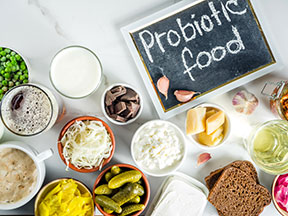
Other foods to consider that contain live cultures (of potentially beneficial) bacteria include:
- kimchi (a Korean fermented cabbage dish)
- sauerkraut (fermented cabbage)
- miso (a fermented soybean-based paste)
- pickles
- kombucha (a fermented tea)
- apple cider vinegar (made from fermented apple sugars)”.
Many fruits, vegetables and leafy greens contain non-digestible fiber (Prebiotics) that serve as a substrate that support the health of your normal gut bacteria (Microbiome).
Probiotics are now widely packages and distributed in the USA and around the world. MyPH suggests that ingestion of the natural foods listed above may be more beneficial preferable to packaged live bacterial cultures in the long term management of your diet.
The following table lists some medical condition for which the use of orally administered probiotics may confer a benefit, based on the abovementioned literature review:
Pouchitis
Infectious diarrhea
Clostridium difficile–associated diarrhea
Helicobacter pylori infection
Constipation
Irritable bowel syndrome
Hepatic encephalopathy
Crohn’s disease
Ulcerative colitis” col_column_max_width=”0.3fr” col_column_min_width=”19px” col_chead_cell_color=”#005752″ col_column_max_width_tablet=”0.3fr” col_column_max_width_phone=”0.3fr” col_column_max_width_last_edited=”on|desktop” _builder_version=”4.22.1″ _module_preset=”default” col_chead_text_font=”|600|||||||” col_chead_text_text_color=”#FFFFFF” col_chead_text_font_size=”20px” global_colors_info=”{}”][/dvmd_table_maker_item][dvmd_table_maker_item col_label=”Probiotic Regimen” col_content=”Primary prophylaxis: VSL #3 3 g per day for 12 months
L. casei GG 6×10⁹ CFU twice per day for 5 days
L. acidophilus 25×109 CFU per day for 2 days then 50×109 CFU per day for the duration of antibiotics OR L. caseai at 19×109 CFU per day, L. bulgaris 1.9×10⁹ CFU per day, S. thermophiles 19×109 CFU per day, all starting within 48 hours of antibiotics and continued for 7 days after antibiotics
Prophylaxis of treatment associated diarrhea: Lactobacillus GG twice daily, ? for the duration of treatment and for 7 days thereafter
L. casei Shirota at 6.5x10⁹CFU per day for 4 weeks OR E. coli Nissle 1917 at 25x109CFU per day for 8 weeks
Bifidobacterium infantis 35624 1×10⁹ CFU per day for 4 weeks OR Bifidobacterium bifidum MMBb 75 1×10⁹ CFU per day for 4 weeks
No recommended regimen
No recommended regimen
E. coli Nissle 1917 at 200 mg per day for maintenance of remission” col_chead_cell_color=”#005752″ _builder_version=”4.22.1″ _module_preset=”default” col_chead_text_font=”|600|||||||” col_chead_text_text_color=”#FFFFFF” col_chead_text_font_size=”20px” global_colors_info=”{}”][/dvmd_table_maker_item][/dvmd_table_maker]